
One of the most common questions we get from people considering their first home barrel isn't really about the barrel at all. It's about everything that comes after. What does this actually cost me over time? How much of my time does it need? Is this a set and forget hobby or something that needs real attention?
A home barrel sits somewhere in between. It doesn't need daily attention, but it isn't entirely passive either. Here's a genuine breakdown of both the cost and the time involved, from your first purchase through years of ownership.
Getting started, the upfront cost
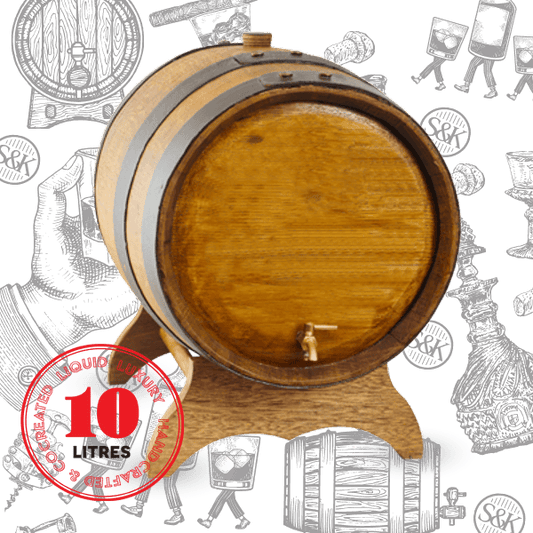
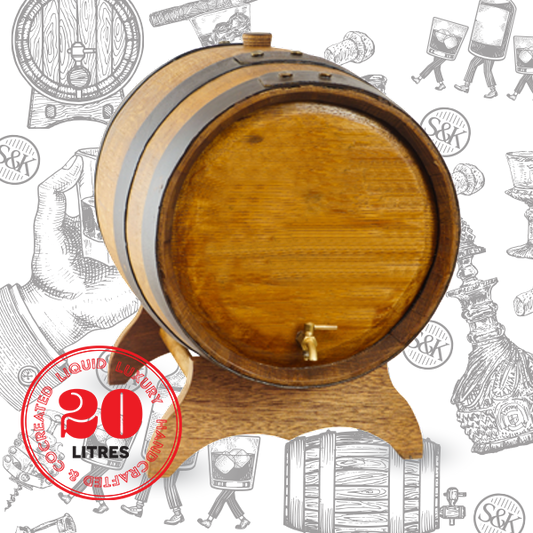
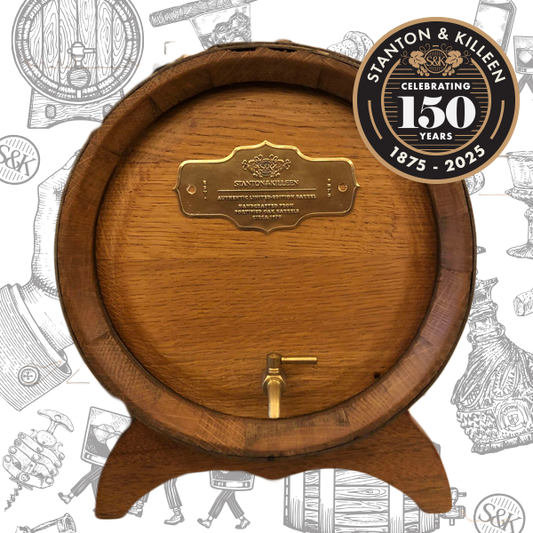
Your first cost is the barrel itself. Liquid Luxury barrels range from a 10 litre through to a 50 litre, handcrafted from minimum 10 year old oak. The size you choose affects almost everything that follows, so it's worth thinking about your realistic drinking volume before committing to a size.
Alongside the barrel, most new owners pick up a few basic accessories to make life easier. A home barrel dipstick for measuring levels, some bung putty and pipe cleaners for keeping the staves and tap in good order. Some clean sample bottles are also handy for drawing down your wine, whether that's for your own tasting or for gifting to friends. None of this is strictly necessary, your barrel arrives with everything you need to get started, but it's nice to be prepared
Then there's your first fill. This is where the ongoing relationship with your barrel really begins, because unlike the barrel itself, the wine inside it is something you'll be managing and adding to for as long as you own it.
Related: How to choose the right home barrel and fortified wine
The ongoing cost, topping up
Every barrel loses wine over time through evaporation, the angel's share. Exactly how much depends on your barrel size and storage conditions, but as a general guide a 5 litre barrel can lose up to 30% of its volume a year in a warm shed, while a 20 litre barrel might lose closer to 10%.
That evaporated wine needs replacing, and this is your main ongoing cost. Our blending fortifieds range from $17 per litre for Standard tiers through to $23 per litre for Deluxe, with Specialty Blends priced higher again for barrel owners wanting to add real age and complexity. Because we sell in 2 litre and 5 litre lots, most barrel owners are topping up somewhere between 2 and 10 litres a year depending on their barrel size and how much they're drinking.
For a typical 10 litre barrel in normal conditions, that works out to roughly $34 to $170 a year in topping wine, depending on how much you're drawing off and which tier you choose. Smaller barrels at the higher end of that range, larger barrels drinking more heavily will sit toward the top of it too.
Larger barrels lose proportionally less to evaporation but hold more volume overall, and if you're drinking regularly from a 20 litre or 50 litre barrel, expect your annual topping wine spend to sit comfortably in that same range or slightly above it, simply because more volume is moving through the barrel each year.
Related: Why is my barrel losing wine? The angel's share explained
Related: How to choose the right topping wine for your barrel
SO2 and maintenance costs
Beyond topping up the wine itself, your barrel needs periodic sulphur additions to stay protected. Our sulphur tablets are $2 for a 2g pack and $4 for a 5g pack, and most barrels only need a small addition every 12 to 18 months. This is genuinely one of the smallest costs in the entire process, a few dollars a year for meaningful protection against oxidation and spoilage.
Related: What is SO2 and does your home barrel actually need it?
Barrel analysis, the free part
If you're a Barrel Club member, sample analysis is included free of charge. Our winemaking team measures your actual SO2 levels and gives you a precise recommendation on what to add and how much, alongside guidance on the right topping wine for your barrel's current character.
We recommend having this done every 12 to 18 months. Beyond the cost of postage to send your sample, there's no charge for the analysis itself, which makes it one of the best value parts of barrel ownership. Getting a professional read on your barrel once a year takes the guesswork entirely out of maintenance.
What about your time?
This is the part that's harder to put a dollar figure on, but it's worth being honest about.
Checking your barrel level takes a quick dip with your dipstick every couple of months, more often in summer when evaporation speeds up. A few minutes, nothing more.
Topping up, when your level drops below three quarter full, takes perhaps ten to fifteen minutes including pulling the bung, pouring, and popping it back in.
Tasting is the part that hardly feels like a chore. Ideally you're tasting your barrel every month or two, both to enjoy what you've built and to keep an eye on how it's developing.
Sending a sample for analysis, once every 12 to 18 months, involves drawing a small sample, packaging it and posting it. Perhaps twenty minutes of actual effort.
Bench trials before topping up take about ten minutes and can save you from undoing months of careful development with the wrong topping wine.
Added all together, a well maintained barrel realistically asks for somewhere between one and two hours of your actual time across an entire year. Everything else is simply waiting, which is the part the barrel does entirely on its own.
Related: How to do a bench trial at home
How long does this go on for?
Indefinitely, in the best possible way. A well maintained barrel, properly topped up and periodically checked, can continue developing for decades. The barrel itself, if cared for, will outlast most other things you own. Many of our longest standing Barrel Club members have owned the same barrel for well over a decade, and their wine keeps getting more interesting every year.
This is really the heart of what makes a home barrel different to almost any other hobby. The cost doesn't scale up dramatically over time, the time investment stays modest, but the character and value of what's inside the barrel keeps compounding for as long as you're willing to keep it going.
The honest summary
A home barrel is not free to run, but it is genuinely affordable relative to what it produces. For a 10 litre barrel, expect somewhere in the order of $34 to $170 a year in ongoing topping wine, plus a few dollars for sulphur, alongside one to two hours of your time spread across the year. In return you get fortified wine on tap, developing in complexity every year, that would cost considerably more to buy bottled at an equivalent age.
If you're considering your first barrel, the ongoing cost and time commitment shouldn't be the thing holding you back. It's genuinely one of the more affordable and low maintenance hobbies you can take up, with a payoff that keeps growing the longer you stick with it.
Related: What to do if you haven't topped up your barrel in months
Related: Your barrel is alive, what winter does to your oak and why it matters
Frequently asked questions
Is a bigger barrel more expensive to maintain?
Not necessarily more expensive per year, but it holds more volume so any top up tends to be a larger dollar amount at once, even though the percentage lost to evaporation is often lower than a smaller barrel. A larger barrel is generally a more efficient long term choice if you have the drinking volume to support it.
Can I reduce my ongoing costs by topping up less often?
We wouldn't recommend it. Letting your barrel sit with significant ullage between top ups increases the risk of oxidation and spoilage, which can cost you far more in a ruined blend than the small amount you'd save by topping up less frequently.
Do I need to pay for barrel analysis every time?
Barrel Club members receive this service free of charge. It's one of the most valuable parts of membership and something we'd encourage every barrel owner to take advantage of at least once every 12 to 18 months.