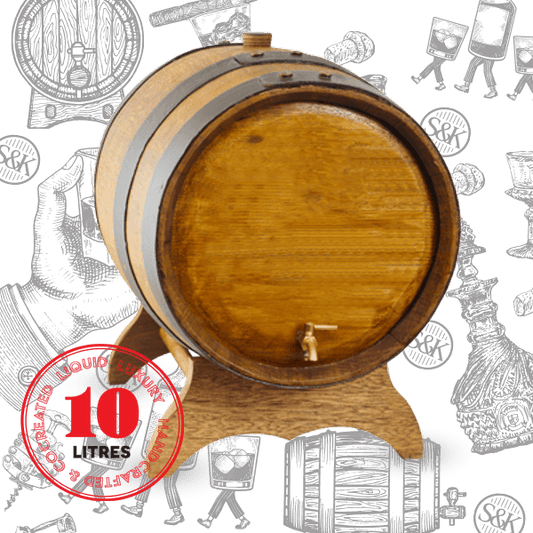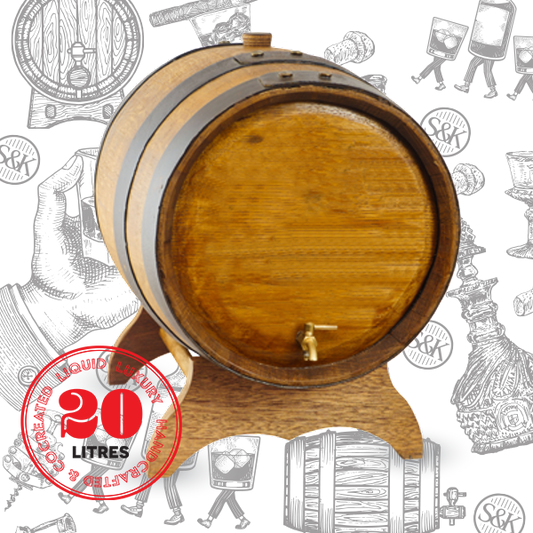

You’re gonna need a bigger barrel.
It’s a common story. You buy a 10L, it’s a hit, and a couple of years later the wine is disappearing faster than the barrel can keep up. Friends are asking for a glass, you’re wondering whether to save some for the Liquid Luxury Wine Show and every time you top up it feels like you’re only replacing what you’ve just drunk.
None of that is a problem. It just means your barrel has done its job. Here’s how to tell when it’s time to upgrade to a bigger home barrel, what a 20L or 50L changes, and how to make the move.
How do you know if your 10L barrel is too small?
You’re drawing more than 2 to 4 litres a year. That’s the range we recommend for a 10L. It keeps your draw off at a level where the older material in the barrel is preserved and you still have room to top up and taste. Go well beyond it and you’re drinking the barrel faster than it can age.
Your barrel never gets ahead. In a small barrel, even a modest top up is a big share of the total, so it pulls the average age back every time. If you’re topping up with young wine to replace what you’ve drunk, your blend never gets the chance to climb. Our post on why the age of your barrel doesn’t equal the age of your blend explains the maths, and it’s the most common reason a barrel feels stuck.
You’re running short when it matters. Christmas, a family gathering, a few bottles to give away, or a Wine Show entry. If you’ve started rationing, that’s a sign.
You’ve started wanting a second barrel. Maybe you’d like to try a different style, or keep a younger barrel to feed an older one. That’s exactly how a home solera begins, and our guide on how to build your own solera system at home shows you how.
Does a bigger barrel let you age wine for longer?
Yes, and this is the strongest reason to upsize. In a smaller barrel, every top up is a larger share of the total, so it pulls the average age back further each time. A bigger barrel absorbs the same top up with far less impact, which means your older wine keeps its age and you can build on it for longer.
Here’s what that looks like. Say you draw 2 litres out of a barrel full of 12 year old wine and top it up with 2 litres of 3 year old Standard, the smallest lot we sell.
In a 10L barrel, you have 8 litres at 12 years and 2 litres at 3 years, and the average age drops to 10.2 years.
In a 20L barrel, you have 18 litres at 12 years and 2 litres at 3 years, and the average age drops to only 11.1 years.
It’s the same top up with half the damage. Repeat that every year and the 10L keeps getting pushed back, while the 20L has room to hold its age and climb. A 50L takes this even further.
What else changes when you move to a bigger barrel?
A smaller share is lost to evaporation. Larger barrels have less surface area for their volume, so a smaller proportion of your wine goes to the angel’s share each year. Our guide on why your barrel is losing wine has the numbers by barrel size.
Development is steadier. More wine means a more stable environment, so the blend ages at a slower, more even pace and is less affected by any one top up.
You can draw more without losing your older wine. A 20L can comfortably turn over 20 to 35% a year, which is 4 to 7 litres, while still keeping a core of older material that builds with every season.
Should you upgrade to a 20L or a 50L barrel?
The 20L is the natural next step for most owners. It roughly doubles your volume, it’s manageable to look after and it suits anyone who wants to build a long term blend and has the drinking volume to support it. If you’re at the top of the range for a 10L, this is almost always the right move.
The 50L is for the committed barrel owner. It’s the slowest to develop and the most stable, and it’s the best choice if you want to build something over decades or share it widely. It’s also heavy and a bigger commitment to fill, so get in touch before you buy and we’ll help you plan the fill and a sensible draw off rate.
If you drink between 2 and 4 litres a year and you’re happy with how your barrel is tracking, there’s no need to change anything. The 10L is the right size for you. Our guide on choosing the right home barrel covers all four sizes side by side.
Do you have to get rid of your 10L when you upgrade?
No. Plenty of owners keep their 10L and use it alongside the bigger one. It can hold a different style, act as a younger barrel that feeds an older one, or simply stay as the barrel you gift or enter in the show.
Just don’t leave it empty. A dry barrel shrinks and leaks, so if you’re moving wine out of it, plan to refill it. If it does dry out, our guide on how to stop a wine barrel leaking covers swelling the oak back up.
How to move up to a bigger home barrel
Decide what you want the new barrel to be. The same style as your 10L, or something different? If you want to carry your blend across, you can use the wine from your 10L as part of the first fill and top the rest up with topping wine. Run a bench trial first, and our guide on how to do a bench trial at home shows you how.
Plan your first fill. At our Standard to Deluxe prices of $17 to $23 per litre, filling a 20L from scratch comes to roughly $340 to $460, and less if you’re carrying your own wine across. Our bulk wine is sold in 2 and 5 litre lots, so a 20L fill is easy to put together. Not sure which tier suits? Our guide on choosing the right topping wine walks through every style and age.
Check your space. A full barrel is heavy, particularly a 50L. Find a level spot on a solid floor, out of direct sun and strong draughts, before the barrel arrives. Our summer barrel care guide has more on where to keep it.
Check your SO2 once the wine has settled. Moving wine around and topping up changes things, so send a sample a few weeks after the new barrel is filled. Barrel Club members get the analysis free, and our guide on SO2 and your home barrel covers what to add.
Know the ongoing costs. A bigger barrel moves more wine through it each year, which means more topping wine. Our breakdown of what’s involved in running a home barrel has the full picture.
Frequently asked questions
How do I know if my 10L barrel is too small?
If you’re regularly drawing off more than 2 to 4 litres a year, running short when you need wine, or finding that your blend never gets older no matter what you top up with, it’s probably time to look at a bigger barrel.
Is a 20L barrel twice the work of a 10L?
No. Checking the level, topping up and sending a sample take about the same time whatever the size. The main difference is the volume of wine you’ll buy to keep it full.
Can I move my wine from my 10L into a 20L?
Yes. Many owners carry their blend across and top up the rest with topping wine. Run a bench trial first so you know how the additions will change the character, and keep your old barrel full so it doesn’t dry out.
Should I get a 20L or a 50L home barrel?
For most owners moving up from a 10L, the 20L is the right size. The 50L suits those who want to build over a very long time and have the volume to support it. Get in touch before buying a 50L and we’ll help you plan it.
Will a bigger barrel make my wine better?
Not on its own. A bigger barrel gives you more stability and more room to build age, but the result still comes down to how you top up, how you look after it and how patient you are.
What is the best size home barrel for ageing fortified wine?
It depends on how much you drink. A 10L suits a light drinker, a 20L suits someone building a long term blend, and a 50L suits someone thinking in decades. The bigger the barrel, the longer you can hold and build age.
The takeaway
If your 10L keeps getting pushed back by every top up, the answer is usually more barrel, not less drinking. The 20L is the natural next step, the 50L is for those thinking in decades, and your existing barrel can keep earning its place in the shed.
Ready to upgrade? Take a look at our 20L and 50L home barrels, and get in touch if you’d like help working out which one suits you.
Questions about your barrel? Our winemaking team is available Monday to Friday at wine@stantonandkilleen.com.au or (02) 6032 9457.